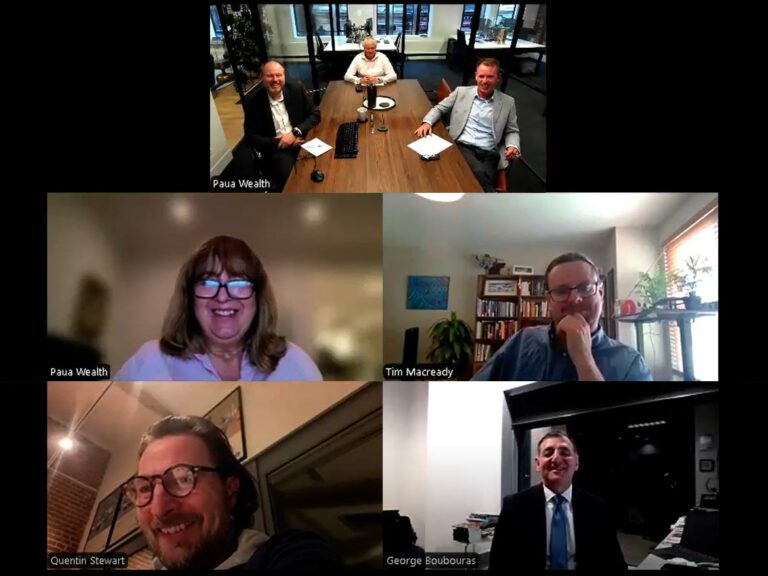
In our first market update for 2026, our Investment Committee (IC) shared their perspectives on what has been an eventful year so far and what we might expect for the rest of 2026. The IC also discussed emerging markets, the rotation from growth to value, yield curves, gold and what investors should consider if they are in the process of deploying capital with the current volatility in markets.
After 3 years of double-digit returns in markets, we are now facing trade wars, geopolitics and fears of an AI bubble. With this backdrop, what’s your view on investment markets?
In aggregate, markets are objectively looking through conflicts and it’s important to acknowledge the ‘theatre and noise’, a theme that we alluded to last year, with respect to current geopolitical events. Coming into the early part of Q1 2026, earnings per share (EPS) estimates were being upgraded, particularly in the U.S. and at the same time multiples in Europe were being rerated because earnings estimates were lower, meaning valuations were cheaper. In addition, global GDP estimates were revised upwards in anticipation of a stronger global growth outlook coming into Q1 2026.
Now we are seeing supply shocks, and it is likely that aggregate earnings will be revised lower, with big tweaks across sectors with energy and hard assets having rallied hard, USD has been a natural hedge. By contrast, U.S. Treasuries and Gold have been flat. That said, they also haven’t sold off or weakened significantly, so may still have a hedging role to play as risk assets have unwound. However, looking forward across all asset classes and the capital structure to the other side of how the Iran conflict pans out. Broadly speaking, valuations are cheaper than three months ago.
Another thing to reconcile concurrently is that most central banks globally have finished their rate cutting cycles or have paused. The European Central Bank (ECB) are sitting at 2%, significantly lower than anywhere else in the world, and they do have a core inflation problem like everyone else. Meanwhile, in the U.S., there may be room for one or two rate cuts depending on how one interprets key economic indicators. Thus, there are many moving parts, however, we are looking through that with things looking reasonable on the other side. Notwithstanding, if oil is at USD125-150/barrel for 90 days, that generally correlates with a high probability of a global recession. We don’t believe this will play out as markets are pragmatic and looking through the conflict, revised valuations are slightly lower, yet earnings are still coming through.
Finally, for calendar year 2025, S&P 500 EPS was around about 12%, with revisions to 10-12.5%, which was the fourth consecutive year of double-digit EPS growth, and we received about a 16% return before income contributions. This year, we are estimating slightly higher aggregate EPS numbers, around 12-14%, however, we see returns around 12%.
Markets are forward-looking and like certainty, which is why we’re experiencing such high volatility. At the end of the day, it is all about earnings expectations and in some instances the baby is being thrown out with the bathwater, creating better entry points for people with capital to deploy and buying opportunities.
Separately, there has been positive news out of the U.S. Court System, throwing out the Federal DOJ case against the Federal Reserve Chairman, Jerome Powell. That had been a large attempt by the U.S. Administration to interfere in Fed policy which would have likely supported asset values in the short-term yet undermined the Fed’s ability to fight inflation and unemployment. The downside to that is, that the trajectory of the Fed is still the same, in that a very strong Trump ally is the nominee—Chairman Powell’s term ends in a couple months—the incoming Chair is likely to follow the current Administrations’ policy very closely. Whilst this isn’t a concern in the short term, it probably supports continued earnings growth and the upward trajectory of asset prices, there is a risk that a Fed that believes tariffs are not inflationary, and wants to keep interest rates low, loses sight of either inflation and unemployment that could be damaging over the long-term. The question is: when does that earnings cycle come to an end and sometimes central bank interventions can precipitate an end in ways that might not have occurred previously.
From a U.S. perspective, people feel that inflation is very real. Even though the inflation rate has come down, people look at prices and feel like they’re significantly higher. It’s interesting to note that much of the war coverage in the U.S. has focused on petrol prices, and hence the real focus in the U.S. is still on the economic outcomes rather than the human cost of a prolonged conflict.
What could be the impact on global growth as a result of the U.S./Israel—Iran Conflict?
As much as the U.S. touts its significant increase in oil production capacity recently, it isn’t immune to the market forces at play as a result of the Middle East conflict, which has caused several countries to release reserves from their national stockpiles. The conflict may in fact contribute to the earnings cycle in certain parts of the economy: for example, missiles need to be restocked, which will create jobs in Defence and lucrative government contracts, resulting in a positive economic impact. The key question here is with mid-term elections approaching, whether the average American voter recognises the potential growth that could come from the increased earnings from defence contractors and negate the inflationary impact of oil prices in the near-term.
Another real issue is demand destruction: when the oil price gets to a certain level, people stop buying other things because they are spending most of their discretionary income on petrol. That scenario can ultimately reduce the oil price because we end up in a recessionary environment, where demand for oil reduces and we achieve a market equilibrium where demand meets supply. We don’t know how long this war will last or how long the Strait of Hormuz will be closed, which creates a lot of uncertainty. Another key question is how long can the world sustain USD100/barrel oil prices? The answer is, quite a long time actually, but if it’s USD150 that might be a different story. Putting this in context, the price of oil increased four-fold in the 1970s, having a major impact on the global economy, and yet today we’re talking about a 30-40% increase, which we believe is at the edges.
What are your thoughts on the transition from growth assets to value?
This rotation is something we have been discussing at IC for the last 12-18 months and it’s gradually starting to happen. It seems obvious in hindsight, however, over the last 24-36 months everyone has been obsessed with the hyper-scalers or Magnificent 7 companies, that could do no wrong and everybody else was left behind. We think it’s good to see the market broadening and that investors are deploying capital into a wider range of opportunities. What this does mean, though, is that the hyper-scalers are reasonably valued, and value stocks are no longer reasonably valued, and that’s the next tipping point that needs to be considered.
The reality of the larger businesses is that they’re network advantaged and have huge, embedded bases, and whilst AI might disrupt their business models it may take a very long time. In fact, it’s more likely that AI would enhance their [incumbent’s] business models and increase the size of their moats. The AI capex spend is hard to reconcile given how significant it is. The EPS upside of 10-20% in future years will no doubt come from the increase in AI related productivity. That’s why transportation, healthcare, and utilities were the beneficiaries of that broadening due to the rotation out of growth. Financials benefited from different stages of the cycle, and they need a steeper yield curve for a re-rating there. However, financials have also done quite well out of the rotation. What is new in the past few weeks is the rally in energy and hard assets, which feels like it could be similar to that 2000-2002 period where hard assets became more important.
Thoughts on the broadening out of markets outside of the U.S. as capital rotates to Europe/UK and Japan?
Ultimately, we believe that capital flows to value. The reality is the U.S. market was much more expensive than the Japanese or European markets, and indeed the Chinese market. Over time, people arbitrage and money moves to the market in which they think they will get the best return. This is a constant process of moving capital to any market where the best opportunities present at any point in time.
On the Capex spend in the AI space, is that sector (tech) still sustainable with a long-term lens?
Whilst earnings are coming through, valuations are much cheaper and it’s likely to stay that way in the short term. The magnitude of the capex spend in the AI space is so significant that people are selling U.S. Treasuries just to participate in the issuance. These businesses are like nation-states. However, these are highly rated, unsecured, investment-grade bonds. So, what does this mean for the real economy?
Regardless of your views on the White House, the U.S. is the most productive economy in the world. The economic cycle on aggregate in the U.S. is quite resilient, and this cycle is delivering productivity gains. This is the reason why Australia gets rate hikes and another two back-to-back with more coming. Unfortunately, in Australia there is expanding GDP with no productivity growth which translates into inflation. Whereas the U.S. has expanding GDP with productivity growth. This is the relativity that you want to note as the U.S. has productivity gains and inflation expectations that are largely in check, with energy independence. Hence, in a relative sense the U.S. is well-positioned to deliver on its EPS growth.
On fixed interest, can we talk about the yield curves?
There is a slight flattening in the U.S., but yield curves are generally suggesting that there is no indication of a collapse in the credit conditions going forward or the earnings environment, so they seem quite resilient and robust. On the funding rate in the U.S., a lot of the $38 trillion of debt is on the short-end of the curve and there is an underweight to these sovereign bonds due to concern around the debt-to-GDP ratio. By contrast, there is increased demand for issuances of investment-grade debt in hyper-scaler companies which are fundamentally well-positioned.
Emerging Markets performance in the past 6-9 months
We’ve been quite aggressively positioned in terms of Emerging Markets exposure relative to our peers. Clearly with the swing to value, some of that enthusiasm is waning. As the USD strengthens due to the geopolitical risks we are experiencing, that is always a signal that emerging markets have historically had issues with strong dollar periods of time, especially countries dependent on oil imports.
Thoughts on Gold given where valuations are at?
Controversially, gold is not an investment, rather it’s an emotional comfort blanket. When you track the performance of gold and silver relative to equities over longer periods, it underperforms. What’s been odd is watching the U.S. equity markets soar as well as gold—why would investors invest in equities as well as gold during a period of geopolitical uncertainty. The big question is: if you bought gold believing that it brought protection in an uncertain environment, at the current price, there is still meaningful potential downside even when equities fall, gold falls as investors seek liquidity. Gold merely acts as a store of value and is used to hedge against certain downside risk, whether it does that in the future remains to be seen.
What would you say to clients looking to deploy capital now, given the volatility and market uncertainty?
Any drop in prices creates a buying opportunity: the market is not complacent, rather it is pragmatic. During the tariff events over that eight-day period last year and the insanity of that drawdown created winners and losers. Once you get to the other side of the conflict, you want real assets because the real economy is growing, and there are productivity gains in certain parts of the world. The market hasn’t given us any of those opportunities yet, but reinforcing the market is being pragmatic, not complacent.
Time horizon matters during periods of volatility and investing for time. Would you be buying equities if you need the money in 3 years’ time? Probably not. The other thing to consider is to deploy capital over a period of time. Yes, there is volatility in markets but you’re best to stay invested. If you’re deploying new capital, think about staging it over time to mitigate the risks during periods of high volatility. The old adage of time in market is better than timing the market in the long run. Also, if you view volatility as opportunity, you can buy assets today relatively cheaper as long as you believe the future earnings potential of those companies are robust.